🔑 Key Takeaways
- The Greater Jakarta Commuter Line (KRL Commuter Line Jabodetabek) still serves approximately 1.2 million commuters daily on weekdays in 2026, making it the primary backbone of mobility.
- Extreme density, especially during peak hours, remains a central challenge despite efforts to increase capacity and modernize the system.
- The government and operators continue to implement strategies for adding train sets, digitalization, and intermodal integration for a more efficient future.
The Greater Jakarta Commuter Line (KRL Commuter Line Jabodetabek), an icon of urban mobility, continues to be the primary pulse for millions of commuters in 2026. Every weekday, its tracks bear silent witness to the daily struggle of approximately 1.2 million passengers who jostle for space, earn their livelihoods, and build dreams in Indonesia's economic heart. This figure not only reflects the massive dependence of Jakarta's satellite cities on this commuter rail service but also underscores the ongoing challenges in providing adequate mass transportation amidst rapid urbanization.
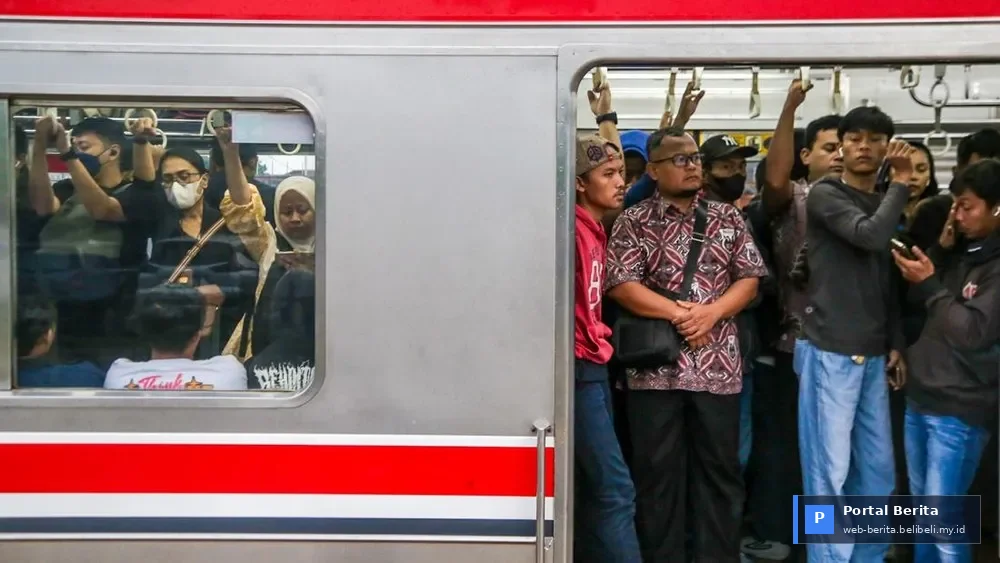
Despite an increase in train sets and station developments, passenger density, especially during the morning and evening peak hours, remains an unavoidable sight. Commuters frequently face long queues at ticket counters or tap-in gates, packed carriages where movement is difficult, and travel times that are not always predictable due to minor incidents or technical constraints.
Challenges Amidst Megapolitan Growth
Dr. Arya Wijaya, an urban planning expert from the University of Indonesia, states, 'The phenomenon of KRL overcrowding is a direct reflection of imbalanced urbanization growth against infrastructure acceleration. Jakarta and its satellite cities are growing very rapidly, yet mass transportation development consistently lags a few steps behind. KRL, with all its limitations, remains the most efficient and affordable solution for the majority of commuters.' He added that without KRL, road congestion would be far worse, paralyzing the economic wheels of Greater Jakarta.
Improvement Efforts and Innovations
PT KAI Commuter, the KRL operator, continues to strive for service improvements to accommodate high demand. Several ongoing and planned initiatives for 2026 include the addition of train sets, modernization of the signaling system to increase travel frequency, and the development of transit stations that are better integrated with other transportation modes such as LRT, MRT, and BRT. Digitalization programs, such as QR ticketing integrated with various payment platforms and real-time train tracking applications, are also being optimized to enhance efficiency and passenger experience.
Economic Impact and Quality of Life
Transport economist, Prof. Budi Santoso, emphasizes, 'The economic impact of KRL is immense. With affordable fares, it enables workforce mobility from buffer zones to the city center, significantly supporting the economic productivity of Greater Jakarta. However, the costs of non-KRL congestion and the decrease in quality of life due to KRL density must also be accounted for as long-term investments in capacity expansion and comfort improvements.' Such investments, he believes, will positively impact public health and worker productivity.
For many commuters, KRL is not just transportation; it's an integral part of their daily routine. 'Even though it's often crowded, I still choose KRL because it's fast and more economical than taking a private vehicle,' says Rina (34), an office worker from Bogor. 'Our hope, of course, is for more carriages, more punctual schedules, and more comfortable stations.' Similar sentiments are echoed by millions of other passengers who rely on KRL to reach their destinations every day.
The Future of Greater Jakarta's Mass Transit
Addressing the challenges of millions of passengers jostling on the KRL is no easy task and requires a long-term vision. Continuous synergy is required among the central government, regional governments, and operators to further develop infrastructure, integrate transportation systems comprehensively, and encourage shifts in public mobility behavior towards a more comfortable, efficient, and sustainable mass transportation system. With meticulous planning and consistent execution, the hope for a better public transportation system in Greater Jakarta's future can be realized.
FAQ
- Why is the Commuter Line still so crowded in 2026? Overcrowding is due to rapid urbanization growth in Greater Jakarta that outpaces existing mass transportation infrastructure capacity, making the KRL the most efficient and affordable option for millions of commuters.
- What efforts are being made to reduce KRL overcrowding? Efforts include adding train sets, modernizing signaling systems, developing integrated transit stations, and optimizing digitalization programs such as QR ticketing and real-time tracking applications.
- Are there plans for new KRL routes or stations in the near future? KRL infrastructure development is ongoing, including the potential addition of new lines and stations, but implementation requires significant time and investment, as well as integration with urban planning.